NDIR vs Dual-Beam CO2 Sensors: Which Should You Choose?
Short answer: choose a direct CO2 sensor—standard NDIR, dual-beam NDIR, or photoacoustic NDIR—based on the complete device specification and use case. Do not treat a MOX “CO2 equivalent” estimate as a direct ppm measurement.
Reviewed: July 19, 2026
Reading Time: 12 minutes
CO2 Sensor Technology Selection Summary
| Sensor Type | What it measures | What it does not establish |
|---|---|---|
| Standard NDIR | Direct infrared absorption by CO2 | The accuracy, drift, or service life of a complete monitor |
| Dual-beam NDIR | Direct CO2 measurement with a second optical channel used as a reference | That the finished device is automatically more accurate than a single-channel design |
| Photoacoustic NDIR | Direct CO2 measurement from pressure waves created by absorbed infrared light | That every photoacoustic module has the same range, accuracy, or power use |
| MOX / CO2 equivalent | VOC-sensitive resistance interpreted as an estimated CO2 equivalent | A direct CO2 concentration suitable for ppm-based ventilation decisions |
Standard versus Dual-Beam NDIR
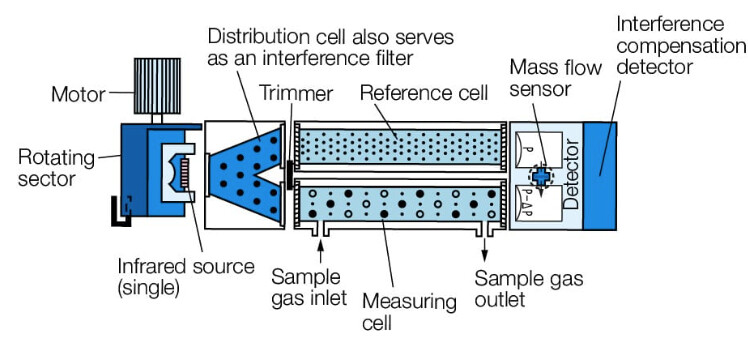
Transmissive NDIR sends infrared light through a measurement cell and derives CO2 concentration from the light absorbed by the gas. A standard single-channel design evaluates the measurement signal against its calibration model. A dual-channel design adds an optical reference channel that can help correct changes in the light source, detector, or optical path over time.
The reference channel improves the basis for long-term optical stability; it is not a certificate of whole-device accuracy. Accuracy also depends on calibration, signal processing, enclosure airflow, thermal design, pressure input, operating range, and handling. Compare the numeric specification under the conditions that apply to the intended use—not the beam count alone. Sensirion's CO2 sensing-principle overview describes both NDIR architectures.
NDIR versus Photoacoustic CO2 Sensing
Both methods are direct optical CO2 measurements. Transmissive NDIR measures how much infrared light reaches a detector after crossing the gas. Photoacoustic NDIR pulses infrared light and measures the pressure wave produced when CO2 absorbs that energy. The photoacoustic approach can support a much smaller measurement cell and low-power modes, but its performance still comes from the particular module and device implementation.
For example, the SCD30 is a dual-channel transmissive NDIR module, while the SCD41 is photoacoustic. The manufacturers' figures below are module specifications under defined test conditions, not interchangeable promises for every complete monitor.
| VisiblAir model | Verified module and principle | Published CO2 accuracy | Selection context |
|---|---|---|---|
| Model C | Sensirion SCD30, dual-channel NDIR | ±(30 ppm + 3% of reading), 400–10,000 ppm | Connected, continuously powered room monitoring |
| Model D | Sensirion SCD30, dual-channel NDIR | ±(30 ppm + 3% of reading), 400–10,000 ppm | Battery-powered local logging and spot checks |
| Model E-Lite | Optional Sensirion SCD30, dual-channel NDIR | ±(30 ppm + 3% of reading), 400–10,000 ppm | Connected indoor CO2, PM, VOC, temperature, humidity, and pressure monitoring |
| Model O | Sensirion SCD30, dual-channel NDIR | ±(30 ppm + 3% of reading), 400–10,000 ppm | Indoor multi-pollutant monitoring with Wi-Fi or wired Ethernet and USB-C or PoE |
| Model X2 | Optional Sensirion SCD30, dual-channel NDIR | ±(30 ppm + 3% of reading), 400–10,000 ppm | Outdoor or indoor multi-pollutant deployments with optional CO2 and multiple connectivity choices |
| Model F (redesign in progress) | Sensirion SCD41, photoacoustic NDIR | ±(50 ppm + 2.5%) at 400–1,000 ppm; ±(50 ppm + 3%) at 1,001–2,000 ppm; ±(40 ppm + 5%) at 2,001–5,000 ppm | Compact portable design; not currently available |
Sources: the linked VisiblAir product specifications plus Sensirion's primary SCD30 datasheet and SCD4x datasheet. An accuracy expression such as ±(30 ppm + 3% of reading) is additive: at 1,000 ppm, the stated tolerance is ±60 ppm under the datasheet conditions. Also distinguish accuracy from repeatability, response time, calibrated range, and drift.
Automatic Baseline Correction versus Manual Verification
Automatic self-calibration (often called ASC or ABC) is not a continuous comparison with a laboratory reference. It infers a baseline from measurement history. Sensirion states that SCD30 ASC assumes its lowest observed concentration represents 400 ppm; the SCD4x default similarly requires regular exposure to air around 400 ppm. A continuously occupied or poorly ventilated location may never satisfy that assumption, while an incorrect forced-recalibration value can deliberately shift the entire calibration curve.
Use automatic correction only where the required fresh-air exposure is realistic. Manual verification means comparing a stabilized monitor with a known concentration or a calibrated reference under the same conditions; forced recalibration should follow only when that reference is valid. Sensirion's SCD30 field-calibration note explains the ASC and forced-recalibration assumptions. For an end-user check, follow the step-by-step CO2 calibration verification guide.
For a focused explanation of false baselines, their effect on alerts and historical data, and VisiblAir's product configuration, read how CO₂ sensor automatic self-calibration works and when to disable it.
Pressure Compensation and Placement Effects
Gas density changes with ambient pressure, so pressure or altitude matters even when the sensing element is stable. The SCD4x interface accepts live ambient pressure or a configured altitude; Sensirion highly recommends live pressure compensation where pressure changes significantly. The SCD30 also supports ambient-pressure compensation. Whether a finished monitor supplies these inputs must be confirmed in that device's documentation.
Placement affects whether the sampled air represents the room. Avoid direct breath, open windows, supply-air jets, heaters, direct sun, and strong turbulence. Manufacturer design-in guidance also warns that trapped air slows response, nearby electronics create thermal gradients, and pressure fluctuations in ducts can add noise. These are reasons to evaluate the complete monitor and its installation, not just its sensor module. See the primary SCD30 design-in guide and SCD4x design-in guide.
Expected Service Life and Common Causes of Drift
Sensirion specifies a 15-year sensor-module lifetime for SCD30 and more than 10 years under a simulated indoor mission profile for SCD4x. Those figures describe the modules under stated operating conditions; they are not a guarantee that every finished monitor, battery, display, or enclosure will last that long.
Documented contributors to offset, drift, or degraded readings include rough handling and shipping, mechanical stress, invalid automatic or forced calibration references, operation outside temperature or non-condensing humidity limits, uncompensated pressure changes, strong airflow or vibration, thermal gradients, direct sunlight, and poor exposure to ambient air. A changing reading is not automatically sensor ageing: occupancy, ventilation, weather, placement, and response time should be ruled out before recalibration or replacement.
Practical Selection Checklist
- For ventilation decisions: require direct CO2 ppm measurement and calculate the accuracy tolerance at the concentrations that matter.
- For continuous room monitoring: verify calibration assumptions, pressure handling, placement, data logging, and maintainability; dual-channel NDIR can support optical stability but is only one factor.
- For compact or power-constrained use: photoacoustic NDIR can be a strong fit, then check its range, measurement mode, battery strategy, and final-device specification.
- For VOC trends: a MOX output may be appropriate, but not as direct CO2 ppm. Bosch's BME680 datasheet, for example, excludes CO2 from gases directly detected by its MOX element.
Choose by how you will measure
The sensing principle is only one part of the decision. When configured for CO2, these current models use direct dual-channel NDIR measurement; the practical difference is how they are powered, connected, and used.
Portable spot checks
Model D runs on an integrated battery and stores local CSV data, so it fits room surveys and inspections without Wi-Fi.
See Model D for portable CO2 checksConnected indoor trends
Model E-Lite adds Wi-Fi, cloud history, and optional CO2 alongside PM and VOC measurements for continuous indoor monitoring.
See Model E-Lite for connected monitoringEthernet or PoE installations
Model O combines CO2, PM, VOC, and NOx with Wi-Fi or wired Ethernet; optional PoE can simplify permanent installations.
See Model O for Ethernet and PoE